Home /
About Ramsgate /
News / A Railway “First” for Ramsgate
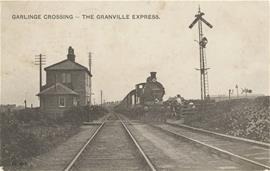
Everybody will have heard of the “Flying Scotsman”, the “Bristolian” and the “Golden Arrow” as they, and many more like them were named trains. (Not to be confused with named locomotives, of which “Flying Scotsman” is one). They all bring back memories of those glamourous days of immaculate locos and high-speed running, which we will always associate with the steam age. But where did it all start? Who first thought of the idea of naming a train? It all started right here in Ramsgate.
In the early 1870’s, the Granville Hotel opened with much publicity. The proprietor arranged with the South Eastern Railway to run a special train for weekend visitors, leaving London on Friday afternoons, and returning from Ramsgate on a Monday morning. So, in March 1877, the “Granville Express” began to run, Great Britain’s first named train.
At first an allowance of 2 hours and 15 minutes was made for the Charing Cross to Ramsgate run via Tonbridge and Ashford, but the inaugural run was completed in 1 hour 45 minutes. So, from April the schedule became 1 hour 55 minutes down, and 2 hours 10 minutes up. After reversal at Cannon Street, the “Granville” ran non-stop to Ramsgate in only 1 hour and 45 minutes for the down journey. The average speed of 48.5mph was an outstanding effort for the time. Over a century later, with electric traction, the fastest time over the same route was 102 minutes with only three extra stops, plus a slightly higher mileage!
From the start the “Granville” was first class only, but from June conveyed second class passengers, and by July was extended to Margate. It left Charing Cross at 3:45pm and returned from Ramsgate at 8:40am.
During 1878, deceleration began with intermediate stops added. History is a little confused for the next decade, as the train bore its name sometimes, otherwise it ran nameless. By 1888, the name “Granville Express” was given to the 3:25pm train from Charing Cross, and the 9:30am “up” from Margate. Both trains ran daily (except Sundays), but the average speed was only just over 40mph. By formation of the South Eastern and Chatham Railway in 1899, the name had disappeared completely form the SER line.
The SER’s great rival, the London Chatham and Dover were quick to respond, and begun running the clumsily named “Granville and Westgate-on-Sea Special Express Train” in April 1878. It ran every weekday, and conveyed passengers of all three classes, leaving Victoria at 3:15pm, called at Herne Hill for a connection from Holborn Viaduct, and ran the 68.5 miles non-stop to Westgate at an average speed of 46mph. Margate was reached at 5pm, Broadstairs at 5:10pm and Ramsgate Harbour at 5:15pm. The return service left Ramsgate at 10am and arrived at Victoria at 12noon.
History is again confusing, as the title of this train was soon altered to the “Granville Express”, so at certain times there must have been two “Granville Expresses” running over different routes to the same resorts. Another “first” for Ramsgate!
Before the First World War, the “Granville” was leaving Victoria at 3:25pm and attaching a portion from Kings Cross at Herne Hill, which arrived there by way of the Metropolitan line, Snow Hill and Ludgate Hill. So, we have an express to Thanet providing a direct service from London’s West End (Victoria), the City (the Kings Cross portion called at Ludgate Hill), the North of England and Scotland. After Herne Hill, the “Granville” was fast to Westgate-on-Sea arriving at 5:50pm, it then called at Margate, Broadstairs and arrived at Ramsgate’s Harbour station at 5:27pm. The up “Granville” left Ramsgate at 10am, with the same stops and took 90 minutes for the non-stop run to Herne Hill where it shed the Kings Cross portion. Victoria was reached in exactly two hours from Ramsgate at 12noon.
By the Second World War the “Granville” was formed of the finest Southern Railway corridor stock, including composite Pullman car serving refreshments throughout the train. The First World War saw the end of the Kings Cross portion, as well as the stops at Herne Hill and Westgate-on-Sea. The express was booked to cover the difficulty graded 74 miles to Margate in 90 minutes, then called at Broadstairs, Dumpton Park (new formation) and arrived at Ramsgate in 1 hour 50 minutes from Victoria (departure 3:15pm, Ramsgate arrived at 5:50pm). Coming up, the “Granville” was away from Ramsgate at 10:10am, made the same calls, plus Westgate, ran non-stop from there to arrive at Victoria at 12:05pm. The normal locomotive to haul the train of that period was a “Schools” 4-4-0, with occasional appearances of “King Arthur” and “Lord Nelson” 4-6-0’s. Loads varied from 9 to 11 bogies [framework on wheels placed under the carriages]. During the period between the end of the Second World War and electrification, the “Granville” lost its name, and numerous stops were added.
The 1953 schedule of the 3:35pm from Victoria was 2 hours and 35 minutes to Ramsgate. Since electrification, Thanet is served by “regular interval” services, and no trace of the “Granville Express” exists today.
Written by:
John Wickham
Photo: The postcard shows the “Granville Express” and is dated May 16, 1906 and is postmarked Garlinge.