Home /
About Ramsgate /
News / If you’re looking to be more sustainable, where do you start?
It’s hard to define ‘sustainable’. It covers a lot of areas and has a few different meanings depending on the context. It can be quite personal too.
Generally speaking, being more sustainable covers three main areas:
- Reducing emissions.
- Making better choices for the sake of nature and biodiversity.
- Being more ethical with people and animals in mind.
One of the more important aspects is that sustainable living must be sustainable for you. No one is perfect, but the more conscious we can be about the way we live, the better.
So, if you’re looking to be more sustainable, where do you start?
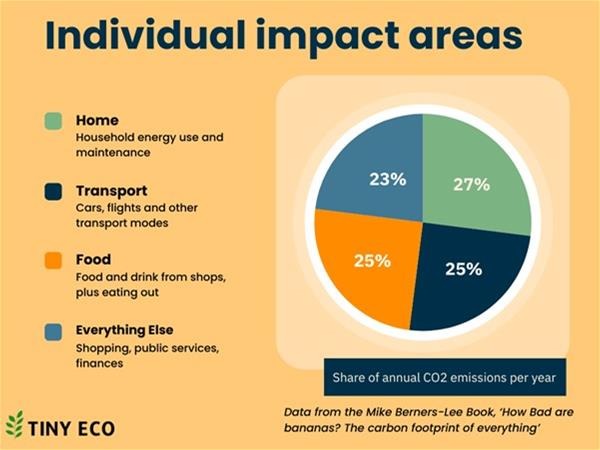
In ‘How bad are bananas?’ by Mike Berners-Lee, there are
four key areas that make up an individual's carbon footprint (often used as a proxy for sustainability, but obviously not covering everything):
- Home (25%) – Household energy use and maintenance.
- Transport (27%) – Cars, flights and other transport modes.
- Food (25%) – Food and drink from shops, plus eating out.
- Everything else (23%) – Shopping, public services, finances.
Five biggest impact actions to be more sustainable
There are so many ways you could go, but if I was to choose five actions for being more sustainable, I'd go with:
- Simply reducing the number of things you buy - This one doesn't need much of an explanation.
- Opting for a second-hand first approach - Already mentioned some of the recent second hand purchases I’ve made. We even reused and sourced second hand on a lot of items for my recent wedding (more on that another time).
- Greening your finances - Such an easy one to do. Earlier this year, I finally managed to switch our joint account away from Natwest. We're now with Nationwide and received £100 for the privilege of switching. Read more on green finances below and watch out for more content coming soon in this area.
- Think about the food you consume - As humans we eat a lot of food - I do at least. Of course, it comes with a fairly hefty footprint. I like to think about the full circle when it comes to food - it’s not just about what you eat. Some potential questions to think about:
Where does your food come from and is it better quality?
Can you source locally?
Organic?
How much meat are you consuming?
How have you cooked your food?
Are you creating much waste?
Are you first of all trying to reduce that waste and secondly composting what's left?
Are you saving cooked food to eat the day after?
Do you have reusable containers or reusable food wraps you can use?
- Reducing energy at home - Via electricity, heating and cooling, buildings account for 21% of total greenhouse gas emissions. Can you make energy efficient improvements, switch to a greener supplier and retrofit where possible to reduce your energy use (and costs)?