Home /
About Ramsgate /
News / The story of how breathing apparatus was invented in East Kent
Protection for the head has been around for years. Helmets were invented as far back as 2500BC to wear during battle. Mass production of helmets is first recorded in 900BC, when helmets were made of bronze. Maybe heads were all the same size then? It's said that people were smaller in those days! Even so I expect they had to adjust it to fit - long faces, round heads. It did the job and stopped injuries from stones and arrows.
We know throughout history that things were adapted to fit the situation and so the helmet evolved. Today there are helmets for everything, and many lives have been saved as the construction of the helmet has been developed. Heads are protected in caves, when climbing, and on bikes and scooters. All of these were thought of and invented. How lucky are we?
The first ever diving helmet came about because of a fire in Whitstable in 1823, when John Dean was visiting friends on a farm there. The town would have had a small population at that time and wide-open countryside. However, the town must have had a bit of money, as they had a fire engine with a pump and hoses to douse any fires.
It must have started like any other visit to see friends. John had gone to his friend's farm. They were having a good yarn, I expect. I wonder at the fear they felt when the cry of fire was shouted out! What would be your first thought as you heard the cry? It was in a building where the horses were kept. At that time, horses were a man's best friend and work mate on a farm. Life revolved around horsepower to work the land.
John Dean knew many horses were trapped in the building as the smoke was growing. The fire engine was called. Even at that time people were aware how smoke could disable one quickly. It is said that John had seen a rusty old mediaeval knight’s helmet somewhere nearby. He ran and got it, fixing a small pipe to the top to allow air out. He got the firemen to pump air into the helmet that gave him enough oxygen to be able to work at freeing the horses.
What a brave man! I expect the adrenalin was pumping as he made his way into the smoke, rising from all the gear lying around. The horse as we know is a big animal and they must have been moving around in fear. He believed his contraption would work and it did.
The helmet worked and his brother, Charles freed all the horses! What a great day. I wonder how he felt afterwards? A stiff drink would have been good! I wonder if he had any burns?
The helmet was adapted into protection that allowed men to be near to and extinguish fires by protecting them from the smoke. The mediaeval helmet had worked and had given them the clues as to how to turn it into useful and lifesaving equipment. Over the next 100 years so many developments were made.
John and his brother, Charles, were both inventive. Charles had invented a “smoke dress” to protect the body: we would now call them protective overalls.
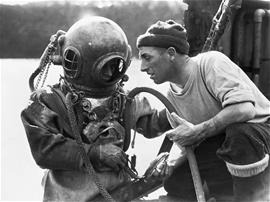
The brothers worked well together on the idea of being able to breathe underwater in a suit, using the helmet that John Dean had invented. They invented the first diving bell, a suit that enabled divers to stay underwater. At the start, the pumps were turned by hand to give the diver air. It was not until 1829 that they were able to start working on the seabed, they were limited by the equipment and experience at that time. The Dean brothers put Whitstable on the map as they sailed out on the first trial. What a day that was in History!
Salvage work would bring the inventors a good return. It was said they even got to dive at the Mary Rose shipwreck and found things until that was stopped. Now we can see so much underwater because of the invention and have had the joy of learning about the creatures that live there, as well as appreciating all the lost treasure that is still being found in the ocean.
John moved around a lot and spent his last years living at 90 Hardres Street, Ramsgate. He is now resting in Ramsgate Cemetery.
If you would like to read more about the subject, there is a slim book by Michael Hunt called “Encounters in the Cemetery”. Also, online there are many photographs of the helmet and Whitstable has a museum and gallery.
Written by:
Councillor Barbara Young
Councillor for Pegwell Ward